
How Masonic Objects Create Meaning
How ritual Masonic objects function as technologies of character transformation

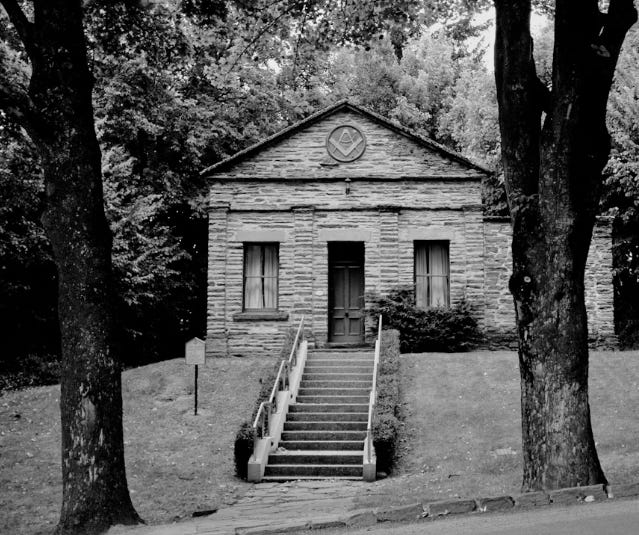
When we tie those strings on our white aprons, or hook the apron’s belt, or when we "square the lodge" as we move about the room, there's something quite remarkable happening. The weight of the gavel and how we use the working tools, are instruments of character formation and a chain of tactile knowledge that goes back hundreds of years. Our Masonic objects are sophisticated technologies of transformation.
In this article I'm exploring the meaning of and value of Masonic objects from my perspective as a cultural (digital) anthropologist. And as a Mason myself approaching three decades in the Craft. Looking at why and how they bring meaning to Masons and their role in bringing meaning and speak to the body's capacity for learning, growth and moral development.
Human's have long been a tool-making species, going back to the Stone Age, around 300,000 years ago when we figured out how to carve out a juicy steak from a Mastodon and cook it up for dinner. Those objects were sacred too. If you owned a stone axe, you had power and influence.
Over time, as we evolved and developed societies and grew our knowledge, we started to create objects that we imbued with deeper meaning. From the Christian cross to the use of words in Islam, totems worshipped in our hunter-gatherer phase, and still seen in current hunter-gatherer societies like !Kung and Maasai today.
Freemasonry has a number of objects, from aprons and gavels, to our jewelled collars, the working tools, geometric symbols, staves and so on. Each of which carries some form of meaning. But we also perform actions physically that are tied into these ritual objects.
Take the square in the square and compasses for example. We talk about the square as "squaring our actions" along with right angles and perpendiculars. The meaning of the square is to convey the concept of being aware of our actions, being direct and considering our moves. We embody this symbol in the physical form when we "square the lodge" in that we move around the lodge room in straight lines, taking squared steps. In degrees, we line up on the north and south sides of the lodge when we bring a Mason into the light.
But the square doesn't jus symbolise moral rectitude. It's physical properties (90 degree angles, inflexible precision) are what philosopher Maurice Merleau-Posty called "motor intentionality", in other words, our body incorporates geometric perfection. Our hands and arms straighten out. This tool literally shapes the neural pathways through repeated tactile engagement and movement.,
These actions, taken to physical form from the square, are considered in anthropology to be "embodied knowledge" where we incorporating the cultural capital of the object into our physical movements. Or as Foucault theorises, this is embodied semiotics, or how the physical object become technologies of the self. It is the idea of sociologist Pierre Bourdieu's concept of habitus.
These objects in Masonry are also what in neuroscience is called "extended cognition" as well, where the tools literally become part of how we think about ourselves and our world. These tools teach us about ourselves and about how we should conduct ourselves in the real world, being upright and of good moral character.
The ritual approach to the altar and the use of the signs isn't theatre. It's postural programming where our body learns reverence through repeated geometric movement. It is the cultural shaping of physical deportment. Our interaction with ritual tools rewires our kinaesthetic sense of appropriate bearing, spatial relationship and measured response.
The material cultural elements of Freemasonry reveal something quite powerful that is rarely seen in any other organisation, it is a fundamental form of somatic inscription. This refers to how we "write" social, cultural, political meanings that we embed onto the body, where the body carries a sort of "text" if you will, as a kind of physical record of our experiences. It communicates meaning through more than just language.
Think of how a master craftsman teaches apprentices. Not through explanation, but by guiding hands, adjusting grip, allowing fingers to learn the "feel" of proper technique. Masonic working tools operate similarly, they're cultural transmission devices that bypass rational cognition entirely. The compass's resistance when drawing circles, the level's delicate balance point, the plumb's gravitational pull - these create what anthropologist David Graeber called "embodied knowledge systems."
This is also another important reason why a purely online Masonic Lodge wouldn't really work. The physical is so deeply intertwined with the meaning of Masonry and cannot be translated to the digital realm, not even in a virtual world. The tactile of donning the apron, holding the gavel and working tools. The muscle memory and movements need to be practised and repeated over time.
Masonic values don't just live in the mind; they're encoded in nerve pathways, muscle tensions and proprioceptive responses. It's another way in which Masonry has translated and created deeper meaning to the actions and objects used by traditional masons.
Objects such as totems and other religious and cultural symbols are a part of every human society and have been for millennia, but the way objects are used in Freemasonry is quite unique, deeply philosophical and highly integrated perhaps more than any other organisation.
Freemasonry is an incredibly rich, complex and multilayered cultural system that coalesces many ancient and more modern ideas, weaving them together in an intricate tapestry of knowledge and wisdom.
About the Author - Giles Crouch, PhD-c, MSc., MM:
A bit about me, the author. I've been a Freemason for 27 years, served as Worshipful Master five times, once for two years in a row, then for three in a row, because, hey, pandemic and no ability to hold elections! I now serve as District Deputy Grand Chaplain. I also spent several years as chair of the communications committee for the Grand Lodge of Nova Scotia. My occupation is as a digital (cultural) anthropologist and you can find my website here.